

Office stripout
How Much Does a Commercial Stripout Cost in Australia?
What drives the cost of a commercial office stripout in Australia? From small offices to large defits, this guide explains the real cost factors and
OFFICE STRIPOUT

Published by
Updated on
Subscribe to get performance-led thinking, industry trends, and real-world lessons delivered straight to your inbox.
We care about your privacy
If you are coming up to the end of a commercial lease, you have probably come across the terms office stripout, defit, and make good. They get used interchangeably all the time, and that causes real confusion for tenants who are just trying to figure out what they actually need to do before vacating.
The short answer is that they are related but not the same thing. Understanding how they fit together can save you time, money, and the kind of last-minute panic that comes from discovering your obligations a few weeks before lease expiry.
This guide walks through exactly what an office stripout involves, how the process works step by step, and how it sits within your broader make good obligations. For a full breakdown of what these works cost, see our companion guide:
How Much Does a Commercial Stripout Cost?
nmgs.com.au/blog/commercial-stripout-cost-australia
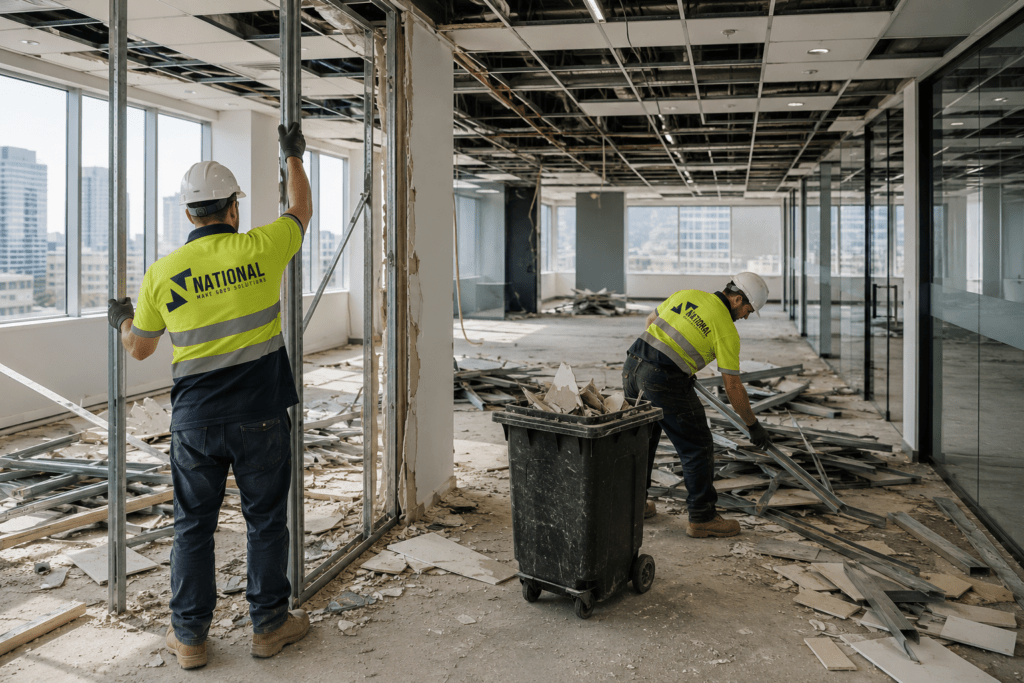
An office stripout – also written as strip-out or defit – is the physical removal of all tenant-installed fitout from a commercial space. That includes partition walls, suspended ceilings, raised access flooring, built-in joinery, kitchenettes, reception counters, cabling, and anything else put in during the tenancy.
The aim is to return the space to base building condition: a blank shell the landlord can re-let or redevelop. Stripouts happen most commonly at end of lease, but also when a business is refitting an existing space or decommissioning a site.
This is the question we get asked most often. Here is the clearest way to think about it:
The simple distinction A stripout is one part of make good. Make good is the full picture. |
Make good is the broader contractual obligation to return a commercial premises to the condition specified in your lease. It is defined by your make good clause and covers everything from surface repairs and repainting through to services reinstatement and a final professional clean.
A stripout is the demolition phase within that process – the removal of all tenant fitout and fixtures. It is usually the first and most visible stage of make good, but rarely the last.
Not every make good requires a full stripout. Some landlords are happy to leave certain elements in place if they add value for the next tenant. What is required comes down entirely to your lease agreement.
Office Stripout | Make Good | |
|---|---|---|
What it is | Physical removal of all tenant fitouts and fixtures | The full end-of-lease restoration obligation |
Scope | Demolition, removal, waste disposal | Stripout + repairs + painting + cleaning + services reinstatement |
Driven by | What was installed during the tenancy | Your lease make good clause |
Who does it | Stripout and demolition specialists | End-of-lease make good contractors |
Defit sits between a full stripout and leaving everything in place. Rather than gutting the entire space, a defit removes specific fitout elements based on what your lease requires or what has been negotiated with the landlord.
For example, a defit might mean removing custom partitions and a kitchenette whilst leaving the carpet, ceiling grid, and base lighting intact if the landlord agrees those items add value for the next tenant.
You are most likely to encounter a defit when your fitout is relatively recent, when you have negotiated a reduced scope with your property manager, or when the incoming tenant wants to retain parts of your setup.
Whether you are doing a full stripout or a targeted defit, the process follows the same sequence.
Before anything happens on site, the make good clause needs to be read carefully. This defines your legal obligations. A thorough scope assessment considers the original base building condition, what was installed during the tenancy, any landlord-approved variations, and the current condition of surfaces and services.
Your contractor prepares a project plan covering trade coordination, access requirements, and waste management. Depending on scope and state, commercial demolition may require building permits. For buildings constructed before the mid-1980s, a licensed asbestos assessment is legally required before any demolition begins.
All building services connected to the fitout must be safely isolated before demolition starts. This covers electrical circuits and data cabling, fitout-specific plumbing, supplementary HVAC, and communications infrastructure. Services disconnection must be carried out by licensed tradespeople and coordinated with building management.
The core of the stripout. Partition removal, suspended ceiling removal, raised floor lifting, joinery and built-ins, floor coverings, and tenant signage are all addressed here. Materials are sorted on site for disposal, recycling, or salvage.
Once the fitout is out, anchor points, penetrations, and surface damage are patched and made good. Base building services are reinstated to their original configuration where required by the lease.
Most commercial leases require walls and ceilings to be repainted in a neutral colour before handover. Surface preparation, priming, and painting in the base building colour specification are completed at this stage.
A professional end-of-lease clean covers carpet shampooing or hard floor polishing, all glass and windows, surfaces, skirting boards, door frames, and complete waste removal from site.
Your make good contractor coordinates a final inspection with the landlord. Any defects or incomplete items are addressed promptly before formal sign-off discharges your lease obligation.
Assuming you know what is required without reviewing the clause leads to expensive surprises. Some clauses are detailed. Others are vague. Both create their own challenges.
Commercial make good requires licensed builders, electricians, and plumbers. Using unlicensed labour can result in defective works, liability issues, and rejection at final inspection.
Any building constructed before the mid-1980s must be assessed by a licensed asbestos assessor before demolition begins. This is a legal requirement under Australian WHS legislation.
Managing multiple trades, building access, permits, waste removal, and landlord communication simultaneously is genuinely difficult. An experienced make good contractor handles all of this on your behalf.
A stripout is the physical removal of all tenant fitouts and fixtures. Make good is the broader end-of-lease obligation that includes the stripout plus all repairs, repainting, cleaning, and services reinstatement needed to return the premises to its original condition as per your lease.
Not always. A defit is typically more selective, removing only specific fitout elements rather than stripping the entire space. Whether you need a full stripout or a targeted defit depends on your make good clause and negotiations with your landlord.
The outgoing tenant is responsible for all make good obligations, including the stripout, unless the lease states otherwise.
This depends on scale and your state or territory requirements. Your make good contractor should advise on required permits or notifications as part of the scoping process.
National Make Good Solutions is a Registered Commercial Builder with over 50 years of experience delivering office stripout, defit, and end-of-lease make good services across Melbourne, Sydney, Brisbane, and nationally throughout Australia.
We manage the entire process from lease clause review and scope assessment through to trades coordination, surface reinstatement, and final landlord sign-off. We offer obligation-free site inspections and written quotes based on confirmed scope.
Contact NMGS: nmgs.com.au/make-good/
Phone: 1300 364 994
Other Guides in This Series → How Much Does a Commercial Stripout Cost in Australia? nmgs.com.au/blog/commercial-stripout-cost-australia → How Much Does a Professional Lease Make Good Service Cost? nmgs.com.au/blog/lease-make-good-service-cost → How to Estimate Make Good Costs for an Office Tenancy nmgs.com.au/blog/how-to-estimate-make-good-costs-office-tenancy → How to Plan an Office Stripout Before Refurbishment nmgs.com.au/blog/how-to-plan-office-stripout-before-refurbishment → Office Defit Checklist for Tenants nmgs.com.au/blog/office-defit-checklist-tenants |
What drives the cost of a commercial office stripout in Australia? From small offices to large defits, this guide explains the real cost factors and

Not sure what an office stripout involves? We break down the full process, how it differs from make good, and what Australian tenants need to
LEASE MAKE GOOD How Much Does a Professional Lease Make Good Service Cost? Published by Updated on Subscribe to our newsletter Subscribe to get performance-led